
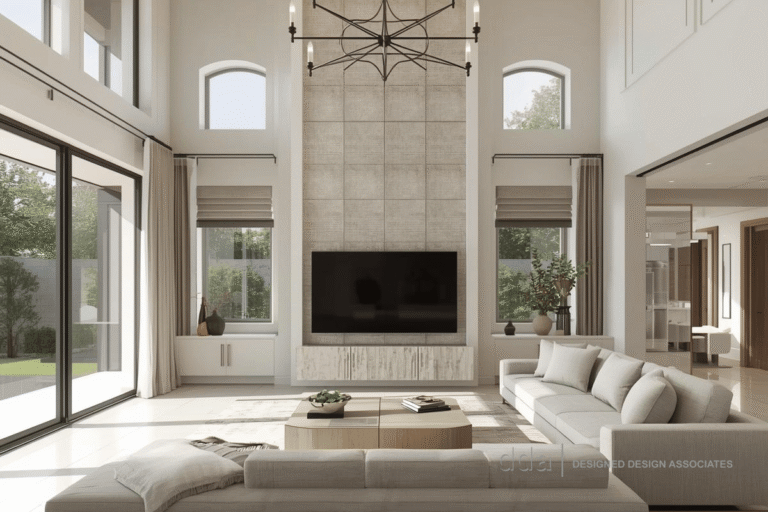
The unique design opportunity of KL’s luxury landed homes
Kuala Lumpur’s premium landed residential market — its Damansara Heights bungalows, its Kenny Hills villas, its Bangsar semi-detached homes, its Ampang hilltop residences — represents some of the most compelling interior design opportunities in Southeast Asia. These are not merely large homes. They are architecturally distinctive properties, often set within mature, landscaped plots, offering spatial possibilities that no condominium or high-rise apartment can match: generous ceiling heights, multiple storeys connected by bespoke staircases, private gardens and pool terraces, courtyards that bring natural light deep into the plan, and the absolute freedom to design every surface, every space, and every detail from first principles. For a luxury interior design company in Malaysia with the experience and creative range to work at this level, a KL bungalow or semi-detached renovation is an extraordinary commission.
The challenge that matches this opportunity is equally substantial. Designing a landed home at a luxury level in Kuala Lumpur requires a comprehensive understanding of Malaysian construction practice, a deep familiarity with the material landscape, and the project management capability to coordinate a large number of specialist trades — structural engineers, M&E contractors, bespoke joinery workshops, stone fabricators, lighting designers, landscape architects — across a project timeline that may extend twelve to eighteen months. It also requires a design intelligence that can hold the entirety of a large, complex project in mind while making hundreds of individual decisions that are simultaneously correct in isolation and coherent as a whole. This is what differentiates a senior luxury interior design studio from a general renovation contractor or an entry-level interior design firm.
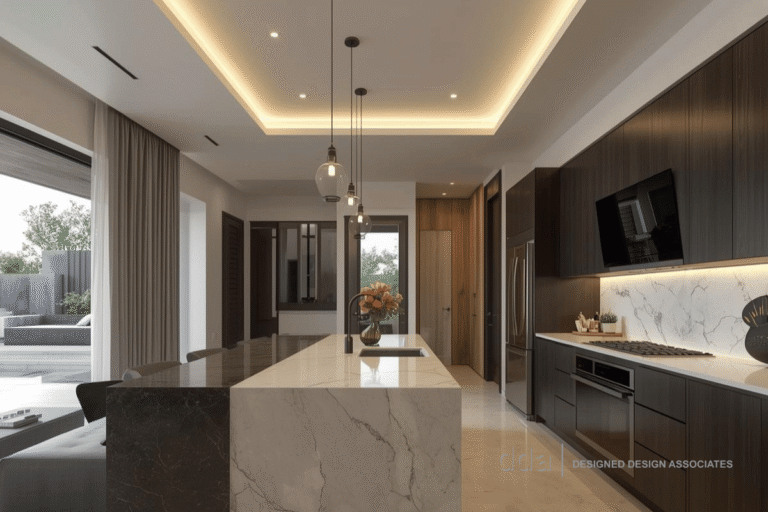
Approach to spatial planning in landed homes
The spatial planning of a luxury bungalow or semi-detached home in Kuala Lumpur begins with an analysis of the property’s existing architecture and the client’s lifestyle brief. In older properties — particularly the mid-century bungalows of Damansara Heights and Kenny Hills that were built for a different era’s living patterns — spatial planning often involves significant reconfiguration: combining previously compartmentalised rooms into open-plan living zones, relocating staircases to improve vertical circulation, introducing light wells or skylights to resolve problematic dark interior zones, or repurposing disused formal spaces (dining rooms that are never used, studies that have become storage) into genuinely functional areas aligned with contemporary living.
The indoor-outdoor relationship is invariably the most important spatial consideration in a KL luxury landed home. Malaysia’s climate makes the garden, pool terrace, and covered outdoor areas among the most valuable and most-used spaces in the home — and the quality of the connection between interior and exterior defines the overall quality of the living experience. At DDA, we approach this connection architecturally: designing the threshold between inside and outside — the choice of door system, the consistency of flooring materials, the relationship between interior and exterior lighting, the way landscaping engages with interior sightlines — as one of the most consequential decisions in the entire project. The goal is a home where the distinction between inside and outside is not defined by a wall but by a gradient of enclosure that responds to comfort, weather, and occasion.
The role of bespoke joinery in luxury landed home design
Bespoke joinery is the element that most directly determines the quality and character of a luxury landed home interior in Kuala Lumpur. In a home of this scale, the cumulative surface area of built-in cabinetry — wardrobes, kitchen cabinetry, study bookshelves, entertainment units, utility storage, staircase balustrades, and panel wall treatments — is vast. The quality of this joinery, and the design intelligence with which it is specified, has more impact on the overall quality of the home interior than almost any other single element. Poorly designed or poorly executed joinery undermines everything around it, no matter how exceptional the flooring or how thoughtfully the lighting is designed. Exceptional joinery — proportioned correctly for the space, detailed with the right level of visual weight, executed in materials that are genuinely beautiful and appropriate to the design concept — elevates every surrounding element.
At DDA, our bespoke joinery design and specification process is one of the most important stages of every luxury residential interior design project. We work with skilled joinery workshops that can execute our designs to exacting standards, whether in local hardwoods, imported timber veneers, lacquered finishes, fluted glass, cane panels, or any of the other materials our design concepts require. We detail every joinery piece fully — every handle position, every shadow gap dimension, every hinge specification — before it goes to the workshop, ensuring that the finished installation matches the design intent precisely. This level of rigour is what distinguishes our interior design services from those of firms that outsource joinery coordination to a contractor without maintaining design control over the outcome.
Integrating smart home technology in luxury KL residences
Smart home technology has moved from a luxury novelty to an expected feature of high-end residential interior design in Kuala Lumpur. But the integration of technology into a luxury home requires design thinking as rigorous as any other element — perhaps more so, because poorly integrated technology is both visible and frustrating, undermining the seamless aesthetic that luxury interior design demands. At DDA, we approach smart home integration as a design discipline: working with specialist systems integrators to ensure that every control panel, every speaker grille, every motorised element — blinds, curtains, gates, pool covers — is specified and detailed as part of the overall interior design, not applied to it after the fact.
The most impactful smart home systems in a luxury KL residence are typically those that manage lighting, climate, security, and audio-visual equipment. Human-centric lighting control — allowing the home to transition through different lighting scenes across the day, from bright morning settings to warm evening atmospheres — transforms the quality of daily life in a way that no other technology matches. Climate control integration, which balances the energy efficiency of natural ventilation with the comfort of mechanical cooling in a way that responds intelligently to occupancy and weather, is particularly relevant in Malaysia’s climate. And security systems that are genuinely comprehensive — CCTV, perimeter sensors, remote access management — provide the peace of mind that is an integral part of what a truly luxurious home should deliver.
DDA's track record in luxury landed home design across Malaysia
With 28 years of award-winning interior design experience across Singapore and Malaysia, DDA has an established track record in luxury landed home projects at the highest level. Our residential interior design portfolio encompasses bungalows, semi-detached homes, terrace houses, and villas across Kuala Lumpur’s most prestigious addresses — Damansara Heights, Kenny Hills, Bangsar, Ampang, Sri Hartamas, and beyond. Each project in our portfolio is the product of a genuinely collaborative design process, a rigorous material and technical specification approach, and a project management methodology that ensures the design intent is fully realised in the finished home. We are proud of the homes we have designed — not just as photographs but as places that their owners love, use, and live in deeply.
If you are planning a luxury renovation of your Kuala Lumpur bungalow, semi-detached home, or villa, DDA would welcome the opportunity to discuss your vision. Our senior interior design team brings the expertise, experience, and genuine creative ambition that extraordinary homes demand. Contact DDA Malaysia today to arrange your initial consultation.
📞 Contact us today to begin your interior design journey .
Q1: What should I consider when renovating a bungalow in Kuala Lumpur?
A1: Key considerations when renovating a bungalow in Kuala Lumpur include: the existing structural condition of the building, which will determine what modifications are feasible and what their cost implications are; the spatial planning opportunity, including which internal walls can be removed, how the staircase can be improved, and how natural light can be better distributed; the indoor-outdoor relationship, particularly how the garden, pool, and terrace can be more effectively connected to the interior living spaces; the selection of materials appropriate for Malaysia’s tropical climate; smart home technology integration; and the selection of an experienced luxury interior design company with a proven track record in landed home projects of comparable scale and complexity.
Q2: How much does it cost to renovate a bungalow in Kuala Lumpur?
A2: Renovating a bungalow in Kuala Lumpur at a luxury level typically costs between RM 600,000 and RM 3 million or more, depending on the property size, the extent of structural modifications, the specification of materials and finishes, and the complexity of bespoke joinery, smart home integration, and landscape works. A mid-sized bungalow of 4,000 to 5,000 square feet with a full premium interior fit-out might cost RM 800,000 to RM 1.5 million. Larger or more architecturally complex properties with imported materials, custom furniture, and extensive landscape and pool works will cost proportionally more. DDA provides detailed project cost estimates following an initial site survey and design brief.
Q3: Why is indoor-outdoor design so important for luxury homes in KL?
A3: Indoor-outdoor design is critically important for luxury homes in Kuala Lumpur because Malaysia’s climate makes the garden, terrace, and covered outdoor areas among the most valuable and most-used spaces in the home. A seamless indoor-outdoor connection — achieved through consistent flooring materials, large-format door systems, aligned sightlines, and thoughtful lighting design — dramatically improves the perceived size and livability of the home. It also creates a connection to Malaysia’s extraordinary natural landscape that is one of the most distinctive qualities that a KL luxury home can offer. The finest bungalow renovations in KL are those where the interior and landscape are designed as a single, cohesive spatial experience.
Q4: What is the difference between a renovation contractor and a luxury interior designer in Malaysia?
A4: A renovation contractor manages the physical construction of a renovation — hacking, structural works, tiling, painting, plumbing, electrical. They execute to a specification but do not typically provide design intelligence or creative vision. A luxury interior designer in Malaysia provides the full design service: space planning, concept development, material specification, bespoke joinery design, lighting design, furniture specification, and aesthetic coordination — as well as project management to ensure the contractor executes the design correctly. For a luxury bungalow renovation in KL, appointing an experienced interior design company rather than simply a contractor is the single most important decision you will make.
Q5: How do I choose an interior designer for a bungalow renovation in KL?
A5: When choosing an interior designer for a luxury bungalow renovation in Kuala Lumpur, evaluate: the firm’s portfolio — specifically whether they have completed projects of comparable scale, complexity, and ambition to yours; their project management capability — large landed home renovations involve many specialist trades and long timelines; their material and procurement network — access to premium suppliers matters for a high-specification project; their design process and communication style — you will be in a close working relationship for 12 to 18 months; and the seniority of the designer who will actually lead your project, not just pitch for it. Ask for references from past landed home clients and visit completed projects if possible.