
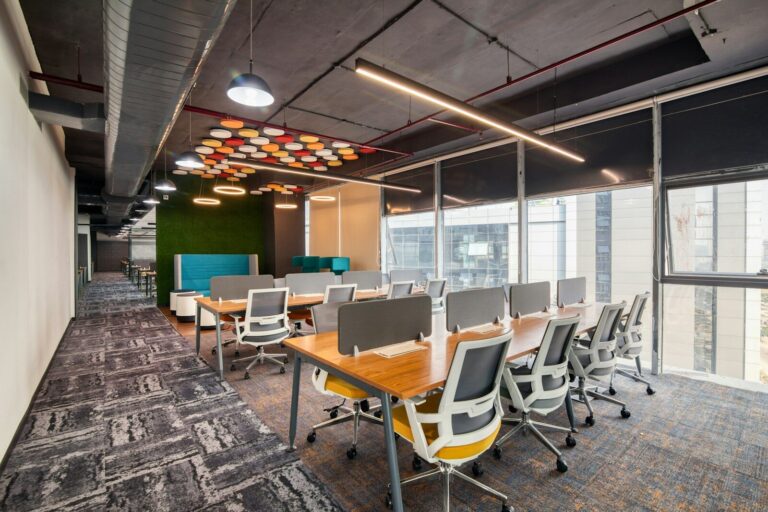
The Malaysian workplace design landscape in 2026
Malaysia’s commercial real estate market is experiencing a period of significant change. New Grade A supply in the Klang Valley — from the continuing development of TRX to the maturation of KL Eco City and the ongoing expansion of established commercial precincts in PJ and the Golden Triangle — is giving Malaysian businesses more choices about where they work than at any previous point. This increased optionality has raised the stakes for workplace design. When a business has the choice between multiple high-quality buildings, the quality of the fit-out it installs becomes one of the primary differentiators in attracting talent and signalling culture to clients and partners.
The Malaysian workplace has also undergone a fundamental structural change in how it is used. Hybrid working — normalised during the pandemic and now an established expectation for knowledge workers across industries — has reduced average daily occupancy in Malaysian offices to between 50 and 70 percent of pre-pandemic levels. This creates both a challenge and an opportunity for office interior design in Malaysia. The challenge is that businesses are paying for space that is not fully occupied on many days. The opportunity is that this underoccupancy can be eliminated — or turned into an advantage — by redesigning the office around purpose rather than headcount. The best commercial interior design firms in Malaysia are helping their clients make exactly this transition, and the results — in terms of employee satisfaction, talent retention, and business performance — are measurable.

Designing for the post-hybrid Malaysian workplace
The central design question for Malaysian offices in 2026 is this: what does the office need to provide that working from home cannot? The answer, consistently, is the same: structured collaboration, spontaneous creative exchange, cultural immersion, mentorship relationships, and client entertainment. These are the activities that require physical co-presence — that cannot be replicated adequately on a video call or a chat platform. And they are the activities that should drive the spatial design of every Malaysian office fit-out. An office designed around rows of individual workstations replicates what a home office does, usually less comfortably. An office designed as a purposeful, high-quality environment for collaboration, culture, and connection gives employees a genuine reason to be there — and gives the business a genuine competitive advantage in recruitment and retention.
Activity-based working (ABW) is the spatial model that has gained most traction in Malaysian offices over the past three years. In an ABW environment, employees do not have assigned desks. Instead, they choose a work setting appropriate to their current task — a focus zone for deep analytical work, a collaboration area for team projects, an informal lounge for brainstorming, a quiet room for calls, a client meeting space for external presentations. The interior design challenge of ABW is to create these diverse settings within a coherent spatial and aesthetic framework — ensuring that the office feels like a single, cohesive environment rather than a collection of disparate zones. This requires significant design intelligence: a strong overarching spatial concept, a disciplined material palette applied across all settings, and a lighting strategy that creates distinct atmospheres in different zones while maintaining visual continuity.
Material and design quality as talent signals in KL offices
The quality of a Kuala Lumpur office’s interior design sends a signal to current and prospective employees that is more powerful than almost any other talent communication. When a new recruit walks into an office for their first interview, the quality of the reception area, the lobby, and the visible workspace behind it communicates the company’s values, financial health, and care for its people more immediately and more viscerally than any employer brand messaging. This is particularly true in KL’s professional services, financial services, and technology sectors, where competition for talent is intense and where candidates are simultaneously being courted by regional and global employers with genuinely excellent work environments.
Premium commercial interior design in Malaysia — characterised by thoughtful material selection, excellent lighting quality, acoustic comfort, and a spatial layout that communicates both professionalism and a genuine regard for employee experience — is increasingly being recognised as a critical talent investment, not an overhead. DDA brings the same rigour to commercial interior design services in Malaysia that we bring to our luxury residential projects. Our office design work encompasses the full scope of commercial interior design: workplace strategy, space planning, concept design, material specification, furniture procurement, M&E coordination, and full project management. We have designed offices for clients across sectors in the Klang Valley and beyond — each one the product of a genuine understanding of how the organisation works and what its people need.
Compliance, sustainability, and the Malaysian regulatory context
Office interior design in Malaysia must navigate a specific regulatory landscape that differs from Singapore’s and requires specific expertise. UBBL (Uniform Building By-Laws) compliance, BOMBA (fire safety) approval, and Green Building Index (GBI) requirements all affect design decisions — from egress planning to material specifications to M&E system design. A commercial interior design company in Malaysia with genuine expertise in this area will manage compliance as an integrated part of the design process, not as a separate exercise that happens after design decisions have been made. At DDA, our commercial projects are designed with compliance requirements fully integrated from the first space plan, ensuring that design quality and regulatory requirements are not in conflict.
Sustainability is increasingly important in Malaysian commercial interior design, driven by both regulatory requirements (for buildings targeting GBI certification) and by client ESG commitments. Sustainable office design in Malaysia involves material procurement from responsible sources, energy-efficient lighting and M&E systems, low-VOC paints and adhesives, and spatial strategies that maximise natural light and natural ventilation. For clients with formal ESG reporting requirements, DDA can provide documentation of sustainable design choices and their expected impact on the building’s environmental performance metrics.
DDA designs offices across Malaysia that balance design excellence with commercial rigour — spaces that attract talent, communicate brand values, and support high performance. Whether you are planning a new fit-out in KL, relocating to a new building, or redesigning an existing space, contact DDA today to arrange a consultation with our senior commercial interior design team.
📞 Contact us today to begin your interior design journey .
Q1: What is the average cost of an office fit-out in Kuala Lumpur in 2026?
A1: A mid-to-high specification office fit-out in Kuala Lumpur in 2026 typically costs between RM 100 and RM 280 per square foot, depending on specification level, the complexity of M&E works, and the extent of bespoke joinery and custom elements. Premium corporate headquarters fit-outs with high-specification furniture, advanced AV systems, sophisticated lighting design, extensive acoustic treatment, and premium material finishes may exceed RM 350 per square foot. Design fees are typically charged separately, at 10 to 15 percent of construction cost, or as a fixed fee agreed at the start of the engagement. DDA provides detailed cost estimates following an initial site survey and brief.
Q2: How does office design affect talent recruitment in Malaysia?
A2: Office design has a direct and measurable impact on talent recruitment in Malaysia. Research consistently shows that high-quality workplace environments are among the top factors cited by candidates when evaluating job offers — particularly for knowledge workers in professional services, technology, and financial services. A premium office interior communicates the company’s values, financial strength, and care for its employees more powerfully than any employer brand messaging. In KL’s competitive talent market, where candidates are often choosing between local employers and regional or global alternatives, an exceptional workplace is a genuine competitive advantage.
Q3: What are the main compliance requirements for office fit-outs in Malaysia?
A3: Office fit-outs in Malaysia must comply with the Uniform Building By-Laws (UBBL), which govern structural, fire safety, accessibility, and ventilation requirements. BOMBA (Malaysia’s fire and rescue department) approval is required for fire suppression, alarm, and egress design. Local council planning requirements apply to any changes to the building envelope or structural elements. For buildings targeting Green Building Index (GBI) certification, specific requirements apply to material specifications, energy systems, and indoor environment quality. An experienced commercial interior design company in Malaysia will manage these compliance requirements as an integral part of the design and construction process.
Q4: What is activity-based working and is it suitable for Malaysian offices?
A4: Activity-based working (ABW) is a workplace design model in which employees do not have assigned individual desks but instead choose from a range of work settings based on the task they are performing — focus zones for deep work, collaboration areas for teamwork, informal lounges for creative discussions, quiet rooms for calls and video meetings, and formal meeting rooms for client presentations. ABW is increasingly adopted in Malaysian offices because it addresses the realities of hybrid working (where 50 to 70 percent of desks may be unoccupied on any given day), creates a more engaging and varied work environment, and allows a given floor area to support more employees than a traditional assigned-desk model.
Q5: How long does an office renovation take in Kuala Lumpur?
A5: A typical office fit-out or renovation in Kuala Lumpur takes between 12 and 24 weeks from design brief to completion, depending on floor area and complexity. The design phase — including space planning, concept design, technical drawings, and material specification — usually takes 5 to 8 weeks. Procurement (including any imported furniture or materials with lead times) and construction typically runs 7 to 16 weeks. BOMBA and building management approvals should be factored into the programme at the outset, as these can add 3 to 6 weeks to the pre-construction timeline. Businesses planning an office relocation or renovation should begin the design process at least 6 months before the required occupation date.